
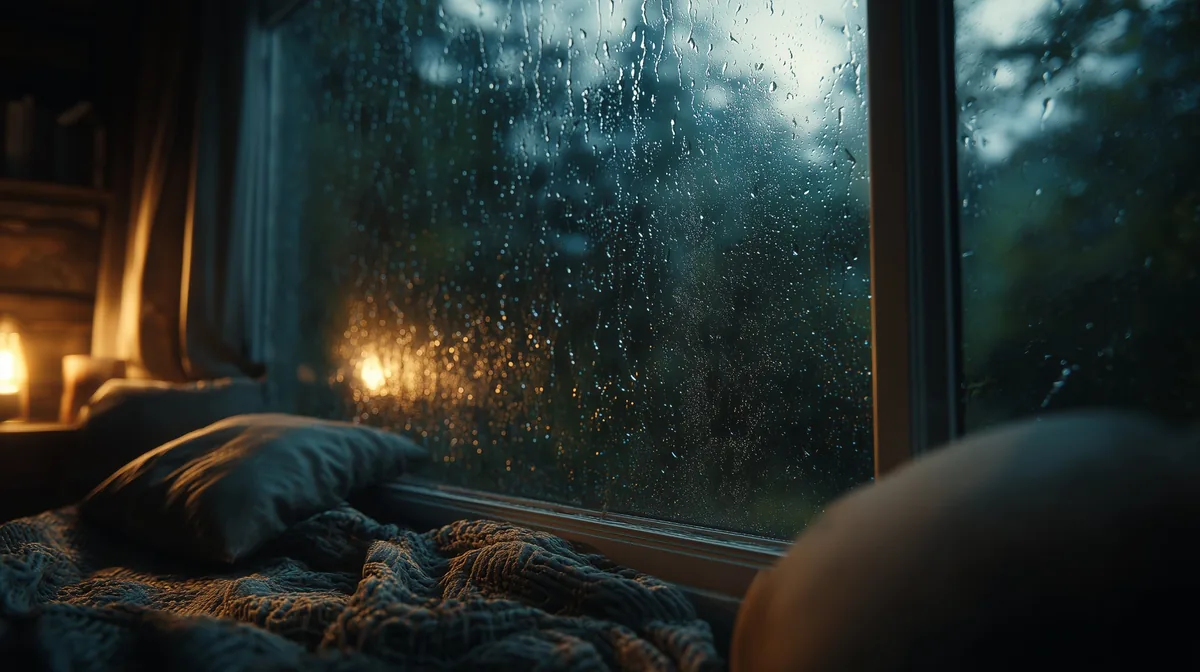
You’ve experienced it before. Rain begins to fall, droplets tapping the window in a steady rhythm, and without warning, your eyelids grow heavy. Rain sounds for sleep aren’t just a trend — they’re backed by neuroscience.
For millennia, humans have fallen asleep to the sound of rain. But only recently has science begun to understand why. And the answer is more fascinating — and more useful — than you might think.

What Rain Does to Your Brain
Pink Noise: Rain’s Hidden Secret
Not all sounds are created equal. White noise — a constant “shhhh” — contains all frequencies at equal intensity. Pink noise is different: lower frequencies are more prominent than higher ones. The result? A softer, deeper, more natural sound.
And guess which natural sound almost perfectly matches the profile of pink noise? Rain.
A study from Peking University (Zhou et al., 2012) published in the Journal of Theoretical Biology demonstrated that pink noise reduces the complexity of brain activity and improves sleep stability. In other words: rain literally simplifies your brain’s activity so it can rest.
The Slow Wave Effect
During deep sleep, your brain produces slow waves. These are responsible for physical recovery and memory consolidation.
Dr. Roneil Malkani, a neuroscientist at Northwestern University, has shown that the frequency profile of pink noise is “very similar to the distribution of brain wave frequencies we see in slow-wave sleep.” This is why rain doesn’t just make you fall asleep — it improves the quality of your sleep.

The 3 Scientific Mechanisms
1. Sound Masking
Rain creates a “sound cocoon” that masks disruptive noises — car horns, neighbors, notifications. Your brain no longer needs to process these unpredictable stimuli, which reduces micro-awakenings and promotes continuous sleep.
2. Parasympathetic Activation
Predictable natural sounds, like rain, activate the parasympathetic nervous system — the “rest and digest” mode. Result: your heart rate decreases, blood pressure drops, and stress hormones (cortisol) are reduced.
A study published in Neuropsychological Trends (2019) showed that rain sounds reduce cortisol secretion and decrease feelings of hostility and anger.
3. The Evolutionary Safety Signal
From an evolutionary perspective, steady rain meant nothing dangerous was happening outside. No predators moving, no immediate threats. This ancestral safety signal is still coded in our brains, which explains why our nervous system “lets go” when rain falls.
Pink Noise vs. White Noise vs. Brown Noise: Which to Choose?
| White Noise | Pink Noise | Brown Noise | |
|---|---|---|---|
| Sound | Uniform hiss (radio static) | Gentle rain, rustling leaves | Waterfall, strong wind |
| Frequencies | All equal | Lower frequencies louder | Very low dominant |
| Best for | Masking noise, focus | Deep sleep, relaxation | Anxiety, deep meditation |
| Nature examples | Distant waterfall | Steady rain | Thunder, river |

How to Integrate Rain Sounds Into Your Routine
Your Evening Ritual in 4 Steps
Step 1 — Prepare the Space (30 min before bed)
Dim the lights, turn off screens. If you have a diffuser, add a few drops of lavender or cedar.
Step 2 — Start the Ambiance
Choose a long-duration rain video (our Sam’Relaxe videos run 3 to 12 hours — no interruptions in the middle of the night). Set the volume to about 50-60 dB — loud enough to mask noise, soft enough not to stimulate.
Step 3 — Breathe With the Rain (5 minutes)
Inhale for 4 counts, hold for 4 counts, exhale for 6 counts. Synchronize your breathing with the rhythm of the rain.
Step 4 — Let Go
No need to “force” sleep. Let the rain do its work. Your brain will handle the rest.
💡 Beyond headphones — For a permanent sound sanctuary, a dedicated white noise machine offers richer, more continuous sound than a phone:
Our pick — Dreamegg D11 Max: 21 sounds incl. 2 rains, rechargeable battery, ultra-compact. The sleep community favorite.
→ See on Amazon
For pink noise — LectroFan: 10 white & pink variations, loop-free precision. Rich sound, compact.
→ See on Amazon
Budget — Magicteam: 20 sounds, 32 volume levels, ultra-affordable to get started.
→ See on Amazon
Bonus design — ThreeH Raindrop: humidifier + LED night light in a raindrop shape.
→ See on Amazon
This article contains affiliate links. If you purchase through these links, we receive a small commission at no extra cost to you. This helps us create free content.
 Enter Rivelyn